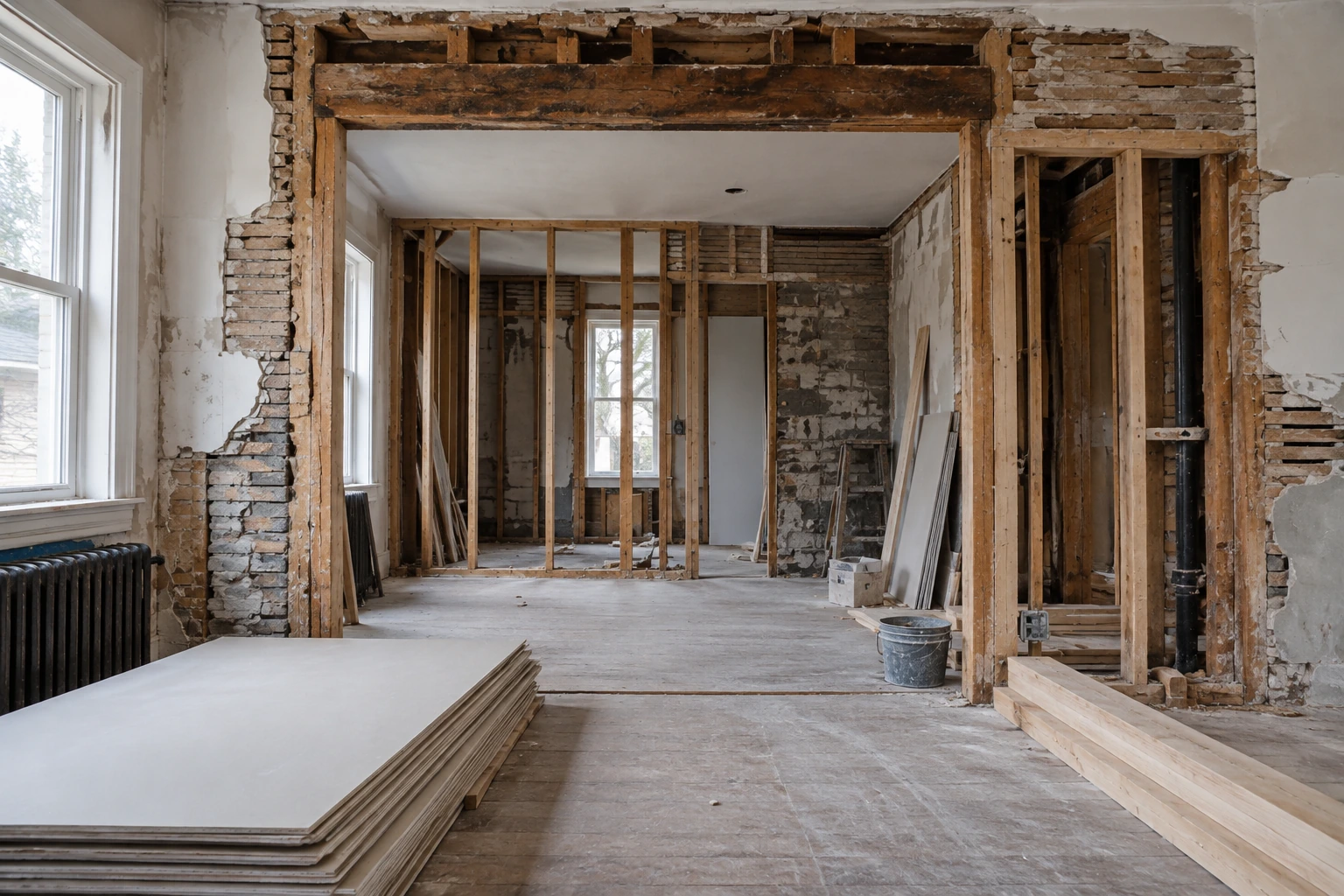
Start by separating the facts from assumptions: what work was proposed, what has actually been done, whether a permit was issued and whether the City has sent any notice. A contractor’s assurance, an old drawing and an application receipt are different documents. Bring the relevant records to the people helping you resolve the project.
This guide explains the City’s published process and a practical way to prepare that conversation. It cannot decide the compliance of work at an address or promise that completed work will be accepted.
First confirm the requirement for the work already done
Toronto’s general permit list includes structural alterations, additions, some basement work and changes to building services. Limited categories are listed as permit-exempt, with conditions. Compare the actual work with that list, then ask Toronto Building about the specific scope if the answer remains uncertain.
Make a factual inventory for the discussion: rooms affected, any walls or foundations changed, services altered and whether another dwelling unit was created. Include dates, photos and documents you already have. This is a preparation method, not a replacement for the City’s assessment or professional design.
- Document the work
Record what was planned, completed and is still underway.
- Check permit requirements
Find the applicable rule and any previous permits or notices.
- Contact Toronto Building
Clarify the required stop-work, drawings and application route.
- Resolve outstanding items
Follow the City’s process for review, inspections and any orders.
Where work requires a permit, Toronto says work must stop while the application is processed.
Read the official sources (last reviewed 2026-09-30)What Toronto says can follow
The City identifies several possible consequences: an additional administrative fee, delay during application processing, undoing completed work or further remedial work. It also explains that the homeowner remains responsible even when a contractor said a permit was unnecessary.
Separate the application task from the construction correction task. One person may prepare drawings while another assesses what was built. Ask what information the City needs and which professional should evaluate the relevant structure or services. Do not assume that the permit package alone resolves every issue found on site.
An administrative fee is separate from the ordinary fee
Toronto’s 2026 fee schedule lists the construction-without-permit charge as the greater of 50% of the permit fee or $214.79, capped at $29,456.99 per permit. These are the City’s listed administrative-fee limits, not a complete statement of every possible cost or consequence.
Keep separate budget lines for the ordinary permit fee, an applicable additional fee, professional review and any required changes to the work. The selected-fee calculator elsewhere on BuildRules estimates a supported ordinary category; it does not calculate the total cost of resolving unpermitted work.
Prepare one clear project record for the next conversation
Organize the scope, completed work, drawings, photographs, contractor correspondence and any City notice in a single folder. Use neutral descriptions of what happened and mark what you do not yet know. A useful question is “What must be established before this project can proceed?” rather than asking someone to endorse a broad assurance that everything is fine.
If you have a permit reference but no drawing package, Toronto’s records disclosure service is the route for requesting previous files. If an existing permit is involved, check its current status and City correspondence as well. A records request and an application for new work are separate tasks.
When the required permit is issued, keep the inspection requirements visible in the project schedule. Toronto’s inspection guidance explains that inspections check work against the issued permit, and the final inspection is part of closing the file. Do not treat resolving the application as the end of the project record.
Your next steps
- Document the actual scope and completed work.
- Contact Toronto Building to establish the requirement and next steps.
- Arrange the appropriate drawings and professional assessment.
- Follow the City’s instructions for approval, corrections and inspections.
Where are you in your project?
Looking up an existing permit or older drawings? Find Toronto building permit records by address.
Common questions
Does paying the additional fee guarantee the work can stay?
No. Treat the fee and the technical assessment as separate issues. The City identifies possible removal or additional work among the consequences.
Can BuildRules decide whether my completed work is compliant?
No. BuildRules explains published guidance. The actual work, required documentation and approval need the responsible authority and appropriate professionals.
Sources & review
Guide reviewed 2026-09-30. Individual source review dates are listed below. The municipality and applicable rules determine requirements for your project.
- Working Without a Permit ↗
City of Toronto · Official source · Reviewed
- When Do I Need a Building Permit? ↗
City of Toronto · Official source · Reviewed
- Building Permit Fees — 2026 schedule ↗
City of Toronto · Official source · Reviewed
- Request Building Records ↗
City of Toronto · Official source · Reviewed
- Building Inspections ↗
City of Toronto · Official source · Reviewed
- Closing Building Permits ↗
City of Toronto · Official source · Reviewed