BuildRules journal / Renovation planning
How to Choose a Tile Flooring Store in the GTA (2026)
Searching for a tile flooring store near you? Compare GTA showroom quality, Toronto tiling costs, return policies, installers and permit questions before ordering.
Sources reviewed October 11, 2026View references

The short answer: The best tile flooring store near you is the one that can show you a floor-rated product, confirm stock and batch information, give you a complete written price, explain delivery and returns, and help you avoid buying tile that will not suit your room. Visit two or three GTA showrooms with the same checklist rather than choosing by display size alone.
Before you visit: Write down the room, approximate floor area, preferred material and whether any plumbing, framing or heating work is planned. Those details change what you should buy and who should install it.
60-second shopping guide
Which tile are you shopping for?
Choose your room before choosing a showroom. You'll know what to ask about the exact product.
Kitchen, entryway or busy floor
Ask for floor-rated tile with suitable wear and cleaning characteristics. Check stock, batch consistency and all-in installation preparation before comparing prices.
Bathroom, shower or laundry room
Check wet-floor suitability, slip-resistance information and the planned waterproofing system. Moving plumbing? That is a separate permit question, not a tile-product feature.
Check plumbing permit guidanceNatural stone or large-format tile
Ask to see full installed displays, shade variation, substrate requirements and maintenance. Confirm that your installer has completed projects with this specific material and format.
Based on HomeStars' Toronto tiler guide. Store-selection advice is editorial, not a ranking or endorsement of particular retailers.
1. Find the right tile store near you, not just the closest one
Searches for “tile flooring store near me” surface a mixture of showrooms, clearance outlets, online suppliers and installers. They do different jobs.
- Showroom: Best when you want to see full displays, compare finishes and bring samples home.
- Tile warehouse or outlet: Useful for a known product or a budget buy, provided you can confirm the exact batch and sufficient stock.
- Specialist supplier: Worth visiting for large-format porcelain, natural stone or a demanding wet-area project.
- Retailer with installation referrals: Convenient, but ask who actually performs the work and whether the retailer is responsible for the installation.
Shortlist stores in Toronto, Mississauga or Oakville based on the collection you need, product expertise, written policies, availability and delivery to your address. Distance matters, but returning a wrong order matters more.
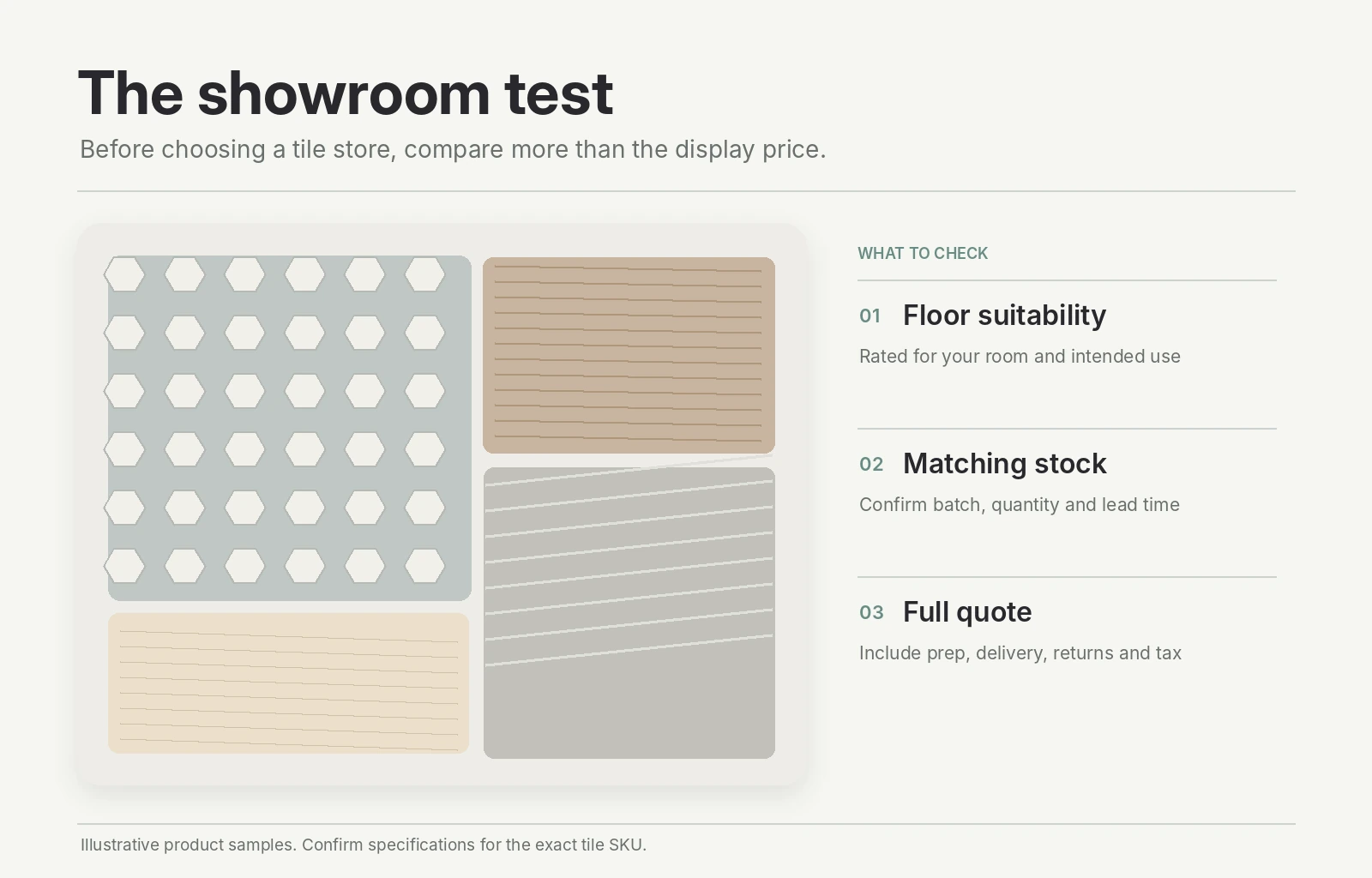
The 60-second showroom test
Ask to see the exact tile installed in a grouted display, not just a small loose sample. Then ask whether it is rated for your intended use. A salesperson who cannot confirm the product's floor suitability should not be deciding your floor.
Takeaway: Don't choose a retailer until you've checked its product advice, stock position and written terms.
2. Start with the room: porcelain, ceramic or natural stone?
Entryway, kitchen or busy floor
Compare products explicitly rated for floor use, considering wear, cleaning and slip resistance. Porcelain can be a strong option, but “porcelain” by itself is not proof of suitability: ask for the exact manufacturer's specifications.
Bathroom, laundry room or other wet area
Ask for the tile's intended floor use and slip-resistance information. Water resistance of a tile is not the same as a properly waterproofed floor or shower assembly. Your installer should specify the substrate and waterproofing system where required.
Decorative wall or backsplash
You may have more freedom with finish and texture, but a beautiful wall tile is not automatically appropriate for floors. Confirm the product application before ordering.
Natural stone
Ask about sealing, maintenance, finish variation and the installer's experience with that particular stone. A sample may not show the full colour variation of an entire order.
Ask the showroom: “Can you show me the manufacturer's floor-use, water-absorption and slip-resistance specifications for this exact SKU?” Don't rely on generic labels or a single rating without context.
3. What does tile flooring cost in Toronto and the GTA?
As a Toronto-specific planning reference, HomeStars reports roughly $15–$30 CAD per sq. ft. for floor tiling in spaces such as kitchens, hallways and living rooms. This is an indicative market range, not a quote, and the included materials and preparation must be confirmed with each installer. Toronto tile installer pricing guide (opens in a new tab).
Why two quotes for the same floor can be far apart
One estimate might include only labour on a ready-to-tile surface. Another can include removal, disposal, levelling, backer board or uncoupling underlayment, waterproofing where relevant, transition strips, grout, trim and tax.
Example, for comparison only: If a retailer or installer quotes a 100-sq.-ft. floor at $15–$30 per square foot, the arithmetic is $1,500–$3,000 for whatever items that quoted rate covers. It is not a verified all-in estimate for your room.
Ask for these lines separately
- Tile material: price per square foot, box coverage and any special-order surcharge.
- Quantity: measured floor area, cuts, breakage allowance and spare pieces.
- Preparation: old floor removal, repair or levelling, substrate and waterproofing.
- Installation: labour, pattern or large-format premium, grout and trim.
- Delivery, disposal, taxes and the written returns policy.
The useful comparison is total scope, not the largest discount on tile.
4. The five questions that separate a good showroom from a risky purchase
You can ask these while standing in the store. A strong answer should be specific to the exact product you want.
“Can I take a sample home?”
Look at it in morning and evening light, beside your paint and cabinets. Check it both dry and wet if that is relevant to its intended area.
“Is the entire quantity available from the same production batch?”
Ask about dye lot, calibre or shade variation, the number of boxes available and the likelihood of obtaining matching stock later.
“What happens if I order too much or receive damaged boxes?”
Ask for the written return/exchange policy for stock items versus special orders, including restocking fees, return deadlines and who pays freight.
“Can you confirm delivery and lead time in writing?”
Special-order and imported collections can take longer. Don't use an unsupported blanket estimate; confirm dates and contingencies with that particular supplier.
“Can you recommend an installer who has worked with this tile?”
Ask whether the retailer simply refers names or takes contractual responsibility for installation. Request examples of comparable completed work.
One line to remember: The best store for your project is the store that will still be useful after you pay.
5. Red flags before you pay a deposit
Pause the purchase when a store refuses written product details, cannot explain what areas the tile suits, or won't disclose final-sale rules on special orders. A vague “it'll be here soon” is not a delivery commitment.
For an installer, beware of an estimate that omits subfloor work, a payment request for the entire job upfront, missing business information or pressure to skip questions about permits.
Ontario's consumer guidance recommends three written estimates, keeping deposits as low as possible (approximately 10% is its recommendation) and using a written renovation contract with scope, price, dates and responsibilities. Those are consumer-protection recommendations; they are not a guarantee of a contractor's quality. See Ontario's renovation consumer guide (opens in a new tab).
What to put in the contract
Record manufacturer, model, size, finish, quantities, preparation, waterproofing where relevant, labour, taxes, delivery, disposal, schedule, payment milestones, changes and warranty. Ask who fixes an underlying floor problem discovered after demolition.
Insurance and WSIB: ask the right question
Request proof of relevant liability insurance and business credentials. WSIB clearance requirements have exceptions for certain home renovations hired directly by an occupant of the residence; it is inaccurate to say every homeowner must obtain a clearance for every tile job. If WSIB clearance applies to your arrangement, confirm the contractor's current status through the WSIB clearance system (opens in a new tab).
6. Does replacing floor tile require a building permit in Toronto?
Usually not for cosmetic tile-for-tile work alone, when you are not changing the structure, installing or modifying plumbing or heating systems, or changing the use of a room. Toronto's public permit list does not specifically list a “tile replacement exemption”; this is a BuildRules interpretation of the work's scope, not a City determination for every property.
The answer changes when the renovation expands beyond the surface finish. The City of Toronto specifically lists structural or material alterations and the installation or modification of plumbing and heating systems among permit-triggering activities. See the City's published rules (opens in a new tab).
Three realistic projects
- Kitchen floor, new tile over a properly prepared existing floor: ordinarily a finish-only job. No new plumbing or structural work is planned.
- Bathroom remodel with a relocated shower drain or new fixtures: don't treat it as “just tile.” Review the plumbing scope and its approvals before buying materials.
- Changing floor joists, floor structure or heating systems: the regulatory answer depends on the exact structural or mechanical work. Electric in-floor heating is a separate approval path. The Electrical Safety Authority (ESA) says installations of electric heating cables or radiant heating pads require an ESA notification and inspection before the cables or pads are covered. Branch-circuit wiring and electrical connections hired out must be handled by a licensed electrical contractor. This is distinct from a municipal building permit. Read the ESA's in-floor heating installation notice (opens in a new tab).
Your next step when the scope includes other work: Check the permit guidance for your address, or review the Toronto interior alteration guide. The selected address, not the article, determines the municipality.
What changes outside Toronto?
Mississauga, Oakville, Brampton and other GTA municipalities administer their own permit processes. Toronto's examples are useful context, not a blanket GTA exemption. Confirm requirements for the municipality of the actual property.
7. A store-visit checklist you can use today
Bring this to each showroom and compare answers side by side.
- Room and application: Is the proposed product genuinely suitable for this floor?
- Specifications: Do I have manufacturer details for wet-use/slip performance where relevant?
- Sample: Can I bring one home and return it if necessary?
- Stock: How many matching boxes are available, and from which batch?
- Full order: What quantity should I buy for cuts and spare pieces?
- Delivery: What is the total charge and confirmed date?
- Returns: Are special orders final sale? Are restocking fees written down?
- Installer: Who installs it, who inspects the subfloor, and who warrants the work?
- Quote: Does it include prep, waterproofing, grout, trim, removal and taxes?
- Scope and permits: Does the renovation include plumbing, structural, heating or other regulated work?
Decision rule: Choose the store that answers these questions best for the product you need. The lowest sticker price should not outrank suitability and a complete quote.
Your next useful step
If this is a straightforward flooring replacement, use the checklist to compare shops and installers. If the plan also involves moving plumbing, altering floor structure or creating a new bathroom, settle those requirements before ordering tile.
Check GTA renovation permit guidance by address · Browse renovation businesses on BuildRules.
BuildRules provides source-backed municipal guidance where coverage exists. An address check is not a permit approval, contractor recommendation or guarantee of complete property data. If the necessary evidence is unavailable, the result should say what still needs confirmation.
A little more clarity
Questions & answers
How do I choose the best tile flooring store near me in the GTA?
Compare two or three stores using the exact tile's floor suitability, showroom displays, take-home samples, matching stock and batch details, written delivery terms, returns policy and a complete price. The closest store is not always the best fit.
How much does tile flooring installation cost in Toronto?
HomeStars' Toronto tiler listing describes typical floor tiling at roughly $15–$30 CAD per square foot, but quotes depend on the work and what is included. Request material, preparation, installation and delivery charges separately.
Is porcelain or ceramic better for bathroom floors?
Neither material name alone guarantees suitability. Check that the exact product is rated for floors and the intended wet conditions, including manufacturer slip-resistance information. Proper waterproofing and substrate preparation also matter.
Do I need a permit to replace floor tile in Toronto?
A cosmetic tile-for-tile replacement without structural changes or new or modified plumbing or heating generally does not require a Toronto building permit. Toronto's guidance does not name tile replacement specifically; verify the full project scope, particularly bathroom plumbing or structural changes.
Can a GTA tile store refuse returns on special-order tile?
Stores may have different written terms for stocked versus special-order products. Ask for the final-sale, damaged goods, restocking, return deadline and delivery policies before placing an order. Applicable consumer rights remain separate from store policy.
Does every Toronto homeowner need a WSIB clearance for a tile installer?
No. WSIB provides an exemption for certain private-home renovations directly commissioned by householders who occupy or will occupy the home. Coverage and clearance requirements depend on the arrangement; ask for appropriate credentials and check the official WSIB rules.
Do electric heated tile floors require an ESA notification in Ontario?
Yes. ESA's electric in-floor heating notice says heating cable or mat installation requires a notification of work and inspection before the heating system is covered. This is separate from municipal building permit requirements; hired electrical wiring must be carried out by a licensed electrical contractor.
Follow the evidence
Sources & references
- HomeStars: Tile Installation in Toronto – local cost estimates ↗
- HomeStars: Tile Installation Cost in Canada (August 2026) ↗
- City of Toronto: When Do I Need a Building Permit? ↗
- Ontario: Your Rights When Starting Home Renovations or Repairs ↗
- WSIB: Clearance Questions and Home Renovation Exemption ↗
- Ontario: Your Rights When Signing or Cancelling a Contract ↗
- Electrical Safety Authority: Electric In-Floor Heating System Installations (Flash 25-08-FL) ↗
Useful for someone else?
Keep this with your project, or send it to the person planning with you.
Keep exploring
A useful next question.
Keep moving with a guide that connects to what you just read.
Garage Door Replacement in Toronto: Permits, Costs & What to Know (2026)
Replacing a garage door in Toronto? Find out when a permit applies, what installation may cost, and the questions to ask before ordering.
Basement Renovation Planning Checklist for Toronto
Organize your basement project before buying finishes: define the scope, collect room information, clarify permit questions, and compare quotes.
Toronto Renovation Measuring Tools: What to Use First
Build a practical room record with tools you may already own, and decide when a tape measure, laser distance meter, or notebook is worth buying.