BuildRules journal / Renovation planning
Garage Door Replacement in Toronto: Permits, Costs & What to Know (2026)
Replacing a garage door in Toronto? Find out when a permit applies, what installation may cost, and the questions to ask before ordering.
Sources reviewed October 11, 2026View references
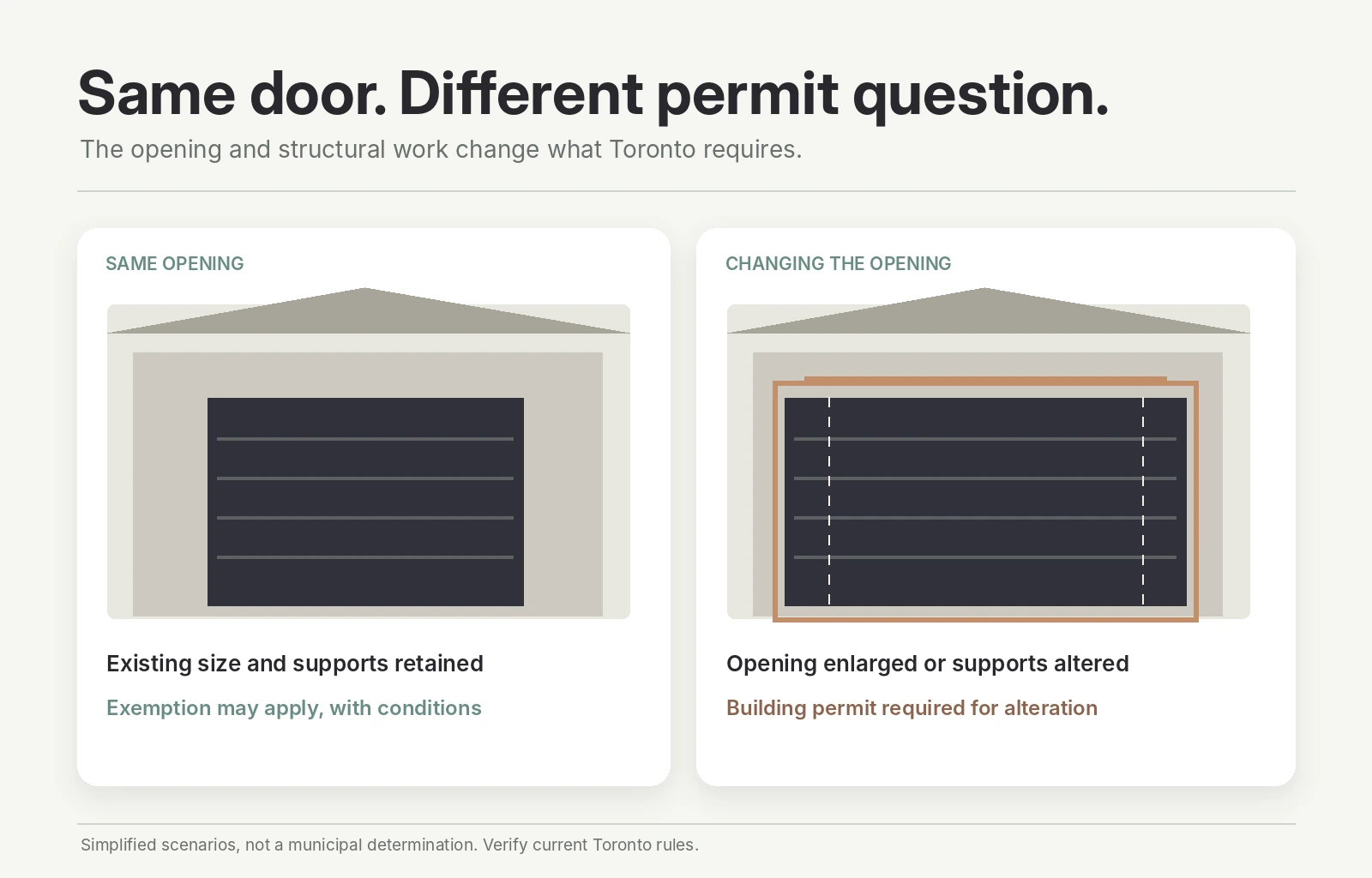
Short answer: You usually do not need a Toronto building permit to replace a garage door in the existing opening of a qualifying single-unit house, as long as the opening stays the same size and location, structural support is unaffected, and no new exit is created. Widen the opening or change its supporting structure, and a permit is required.
What the official rule actually says: Toronto's published exemption refers to replacing an existing “window or door” in qualifying houses; it does not specifically name garage doors in that wording. BuildRules interprets that exemption as a starting point for like-for-like garage-door work when its listed conditions are met. If the garage opening or supports are unusual, ask Toronto Building to confirm (opens in a new tab) before work begins.
The detail that changes the answer: Are you replacing just the door, or changing the building around it?
Planning a replacement? Check your Toronto address and project guidance. No account needed.
Your project, your next decision
What's changing about your garage door?
Choose the situation closest to yours. The opening matters more than the door style.
I'm replacing the door in the same opening
Often no building permit for an eligible single-unit house or its accessory building if the opening's size and location stay the same, structural supports remain unaffected, and no new exit is created. Other approvals can still matter.
I'm making the opening wider or taller
A building permit is required for enlargement or structural alterations under Toronto's published guidance. Have the structural work and permitting scope confirmed before ordering the door.
It's a multi-unit or heritage property
Check additional requirements. Toronto's published replacement exemption is limited to certain houses. Designated heritage properties can also need separate approvals for exterior changes.
Toronto permit scenarios are based on City guidance. Cost and time figures are Canada-wide estimates; see sources below. BuildRules provides guidance, not municipal approval.
1. Which garage door project are you actually planning?
The words “garage door replacement” can describe three very different jobs. Find yours before you compare prices.
A. Same opening, new door
You're swapping a damaged or outdated door for a new one. The opening remains the same size, in the same place. Its structural supports stay untouched, and no new exit is created.
Likely permit outcome: No building permit for an eligible detached, semi-detached or row house containing a single dwelling unit, or an accessory building serving that house. The City's exemption has these specific conditions. Read Toronto's official rule (opens in a new tab).
Next decision: Choose the right door and compare installation quotes. If you're unsure whether the structure will be affected, ask before ordering.
B. A wider, taller or relocated opening
Maybe you want a taller door for a vehicle, or one double door where there were two singles. The change could involve a new header, removing a centre support or changing structural framing.
Permit outcome: Toronto lists enlarging or relocating a door opening and structural alterations among work requiring a building permit.
Next decision: Get the proposed structural scope reviewed before committing to the door size. Don't treat the cost of structural work as part of an ordinary door-installation quote.
C. A multi-unit building or designated heritage property
Toronto's published door-replacement exemption is limited to particular house types. Its guidance also lists door replacement in other building types among work requiring a permit. Designated heritage properties can require separate approval for exterior changes, including some work that would not otherwise need a building permit.
Next decision: Confirm the building type and heritage status before assuming a like-for-like replacement is exempt. See Toronto's heritage guidance (opens in a new tab).
Remember: “Same-size replacement” describes the opening and structural work, not just the dimensions printed on the new door's product sheet.
2. How much does garage door replacement cost in Toronto?
Toronto-local reference: HomeStars' Toronto garage door installation listings (opens in a new tab) describe $1,000–$2,500 CAD for many standard local installations, while more complex jobs can approach $4,000 or more. This is a guide to expected prices, not a verified quote for your particular replacement.
Full replacement reference: HomeStars' August 2026 Canada-wide replacement cost guide (opens in a new tab) estimates $1,500–$4,000 CAD installed for many standard replacements.
Why do the figures differ? One source discusses local installation services; the other focuses on full replacement costs across Canada. Door materials, included hardware, disposal and the scope around the opening are not necessarily identical. Compare the same included items when obtaining Toronto quotes.
The model and material make a difference:
- Non-insulated steel: approximately $1,000–$2,500 installed for a single door.
- Insulated steel: approximately $1,500–$3,500 installed for a single door.
- Aluminum and glass: approximately $1,800–$4,500 installed for a single door.
- Custom wood or carriage-style: approximately $3,000–$10,000 installed for a single door.
Ranges are reported by HomeStars' 2026 Canadian garage door cost guide (opens in a new tab). Size, location, hardware, disposal and the work required around the opening can all change the price.
The cheapest quote is not always the cheapest project
Before accepting a price, ask whether it includes removing the old door, tracks and springs rated for the new door, weather seals, opener compatibility, installation, disposal, taxes and warranty work.
The expensive surprise to avoid: Discovering after you have ordered the door that the opening needs structural changes. Get that assessed first.
3. What does a Toronto building permit add to the cost?
If your work falls under Toronto's published exemption, a building permit is not needed for that exempt replacement.
If the proposed work requires one, Toronto's 2026 minimum building permit fee is $214.79. This is the minimum published fee, not a flat “garage door permit price.” The actual fee is calculated using the City's applicable fee categories and project scope. Drawings, structural design and other approvals can cost extra.
See Toronto's official 2026 permit fee schedule (opens in a new tab).
Useful distinction: The door installation budget, building permit fee and possible structural design costs are three different numbers. Ask contractors to separate them.
4. One-day installation or a longer construction project?
A straightforward single-door replacement can take around three to five hours of on-site installation, according to HomeStars. A larger or more complicated installation may take most of a day.
That does not mean you'll have a new door installed tomorrow. Ordering a custom size or finish can add lead time. Structural changes, municipal approvals and scheduling can extend the project further.
For complete applications in Toronto's House Stream, the City states a 10-business-day review period. This is a review standard, not a guaranteed permit-issuance date or total project duration. Incomplete applications have no defined review timeframe. See the City's review-stream rules (opens in a new tab).
Before booking a date, ask: Is the door in stock? Does the opening need work? Does a permit apply? Who handles any application?
5. Is an insulated garage door worth paying more for?
The better question is how you use the garage.
Your garage is attached to the house
An insulated, well-sealed door may help moderate temperature swings and noise. It is especially worth considering if you spend time working in the garage or have living space next to it.
Your garage is detached and unheated
For a space used only for occasional parking or storage, the premium for high-performance insulation may offer less practical value.
Your garage feels cold even with an insulated door
Don't assume another door will fix everything. Walls, ceilings and air leakage also matter. A garage door upgrade isn't a substitute for addressing those conditions.
Buying filter: Ask for the door's actual construction, insulation specification, weather sealing and warranty. Compare those details alongside the installed price.
6. Five questions to ask before you hire an installer
Use the same questions with every contractor. You'll get quotes you can actually compare.
- Will the size or location of the existing opening change? If yes, clarify permits and structural work first.
- Are the tracks, springs and opener compatible with the new door? Get any replacements itemized.
- Does the installed price include removal, disposal and taxes? Don't compare incomplete totals.
- What is the real delivery and installation timeline? Ask separately about stock and on-site work.
- Who is responsible for permits and required inspections, if any? Get the responsibilities in writing.
One extra question can save a return visit: What happens if the installer finds damaged framing when the old door comes off?
7. Outside Toronto? Don't copy Toronto's permit answer
North York, Scarborough and Etobicoke are within the City of Toronto. Mississauga, Vaughan, Brampton, Markham and Richmond Hill have their own municipal procedures.
The province-wide building-code context doesn't make every city's guidance interchangeable. Use the rules for the address where the work is happening.
Have an address ready? Check the local starting point on BuildRules. The address determines the applicable municipality.
Your next move: clarify the project, then compare installers
If you're keeping the opening unchanged, confirm the exemption conditions and ask for comparable door-installation quotes. If you're widening or moving it, settle the permit and structural questions before ordering the door.
**Check address-based permit guidance** or browse building and renovation professionals.
BuildRules explains published municipal guidance; the municipality determines approvals. Where structural assessment or a heritage determination is needed, obtain the appropriate professional or municipal confirmation.
A little more clarity
Questions & answers
Do I need a permit to replace a garage door in Toronto?
Usually not for a same-opening replacement in an eligible single-unit detached, semi-detached or row house, or its accessory building, when the opening's size and location, structural support and exit arrangement remain unchanged. Otherwise, check the applicable Toronto requirements.
Do I need a permit to widen a garage door opening?
Yes. Toronto lists enlarging or relocating door openings and structural alterations as permit-required work.
How much does garage door replacement cost in Toronto?
A Canada-wide 2026 estimate for many standard installations is $1,500–$4,000 CAD, but the actual Toronto cost depends on the door, opening, hardware and contractor quote. Structural work is separate.
How long does replacing a garage door take?
A straightforward single-door replacement may take around three to five hours on site; custom-door delivery, structural changes and municipal approvals can extend the project.
Are garage door replacement rules the same across the GTA?
No. Toronto's published guidance does not automatically apply in Mississauga, Brampton, Vaughan, Markham or Richmond Hill. Check the municipality where the property is located.
Follow the evidence
Sources & references
- City of Toronto: When Do I Need a Building Permit? ↗
- City of Toronto: Building Permit Fees (2026) ↗
- City of Toronto: Building Permit Review Streams ↗
- City of Toronto: Heritage Permit Guide ↗
- HomeStars: Garage Door Replacement Cost in Canada (2026) ↗
- HomeStars: Garage Door Installation Services in Toronto (local price guide) ↗
Useful for someone else?
Keep this with your project, or send it to the person planning with you.
Keep exploring
A useful next question.
Keep moving with a guide that connects to what you just read.
How to Choose a Tile Flooring Store in the GTA (2026)
Searching for a tile flooring store near you? Compare GTA showroom quality, Toronto tiling costs, return policies, installers and permit questions before ordering.
Basement Renovation Planning Checklist for Toronto
Organize your basement project before buying finishes: define the scope, collect room information, clarify permit questions, and compare quotes.
Toronto Renovation Measuring Tools: What to Use First
Build a practical room record with tools you may already own, and decide when a tape measure, laser distance meter, or notebook is worth buying.